04.08.14

MASTER BOX. Транспортер боєприпасів Panzer I Ausf. A (Munitionsschlepper auf Pz.Kpfw.I Ausf.A) 1/35

Pz.- I A під час служби у Leibstandarte-SS «Adolf Hitler»
Бої на Східному фронті в 1941 році показали повну нежиттєздатність легких кулеметних танків в умовах війни в Росії. За заявою командування однієї з танкових груп, танк, озброєний гарматою калібру менше ніж 75 мм., не мав на Східному фронті ніяких шансів на виживання. У 1942 році танки Pz.-IA i Pz.-IB були зняті з озброєння. Частина цих машин була переоснащена в транспортери боєприпасів. З машин були демонтовані башти, а на їх місце поставлені зварені металеві ящики простої форми, відкриті зверху. Відомо, що 12 таких машин проходили службу в Лейбштандарт СС "Адольф Гітлер"

Battles of the Eastern front in 1941 have revealed complete helplessness of light machine-gun tanks in conditions of war with Russia. As commanders of one of the tank groups said, the tank equipped with a gun of less than 75 mm caliber had no chances to survive on the Eastern front. In 1942 the tank models Pz.-1 A and Pz.-IB had been withdrawn from the arsenal. Part of those machines was reequipped  into ammunition transporters. Turrets were dismounted and welded metal boxes of simple shape opened on the top were mounted instead. It is known, for example, that 12 such machines operated at Leibstandarte SS "Adolf Hitler"


24.03.13

Zvezda. Німецький важкий танк Pzkpfw. VI Tiger Ausf. H1 (Sd.Kfz.181) 1/35

Цей танк являється самою відомою броньованою машиною періоду Другої Світової війни. Вогнева міць і тяжка броня робили його смертельно небезпечним противником для радянських танків і танків союзників на протязі 1943-45 рр. В травні 1942 р. танк "Тигр" почав поступати на озброєння німецької армії. В вересні 1942 р. в боях під Ленінградом відбулося його бойове хрещення. Після того  танки "Тигр" приймали участь у всіх бойових діях на всіх фронтах у Європі та Африці.

The Tiger I was a German heavy tank of World War II deployed from 1942 in Africa and Europe usually in independent heavy tank battalions. Its final designation was Panzerkampfwagen VI Tiger Ausf. E often shortened to Tiger. The Tiger I gave the Wehrmacht its first armoured fighting vehicle that mounted the 8.8 cm KwK 36 gun (not to be confused with the 8.8 cm Flak 36). 1,347 were built between August 1942 and August 1944. Production was phased out in favour of the Tiger II.
While the Tiger I has been called an outstanding design for its time, it was over-engineered, using expensive materials and labour-intensive production methods. The Tiger was prone to certain types of track failures and breakdowns, and was limited in range by its high fuel consumption. It was expensive to maintain, but generally mechanically reliable. It was also difficult to transport, and vulnerable to immobilization when mud, ice and snow froze between its overlapping and interleaved Schachtellaufwerk-pattern road wheels, often jamming them solid. This was a problem on the Eastern Front in the muddy rasputitsa season and during extreme periods of cold.
The tank was given its nickname "Tiger" by Ferdinand Porsche, and the Roman numeral was added after the later Tiger II entered production. The initial designation was Panzerkampfwagen VI Ausführung H (‘‘Panzer VI version H’’, abbreviated PzKpfw VI Ausf. H) where 'H' denoted Henschel as the designer/manufacturer. It was classed with ordnance inventory designation SdKfz 182. The tank was later redesignated as PzKpfw VI Ausf. E in March 1943, with ordnance inventory designation SdKfz 181.

Я думаю всім відомі недоліки цієї моделі, малюнок на бокс-арті не відповідає дійсності на 100%, танк з таким бортовим номером дійсно існував але багато в яких деталях відрізнявся від зображеного на малюнку. Тепер про те що знаходиться в середині коробки. Це варіант так званого "африканського" Тигру, який по суті не відрізнявся від інших Тигрів, хіба що мав повітряні фільтри великого об"єму «Feifel» (хоча переглядаючи архівні фотографії на Східному фронті теж можна зустріти танки з цими фільтрами) та щитки прикриття вихлопних труб іншої форми і ще деякі зміни. Я вирішив збудувати модель танку в діях на Східному фронті з мінімальними переробками, орієнтуючись на ці фотографії, з декалей будуть тільки тактичні знаки без номерів (Н-ська військова частина).


18.06.12

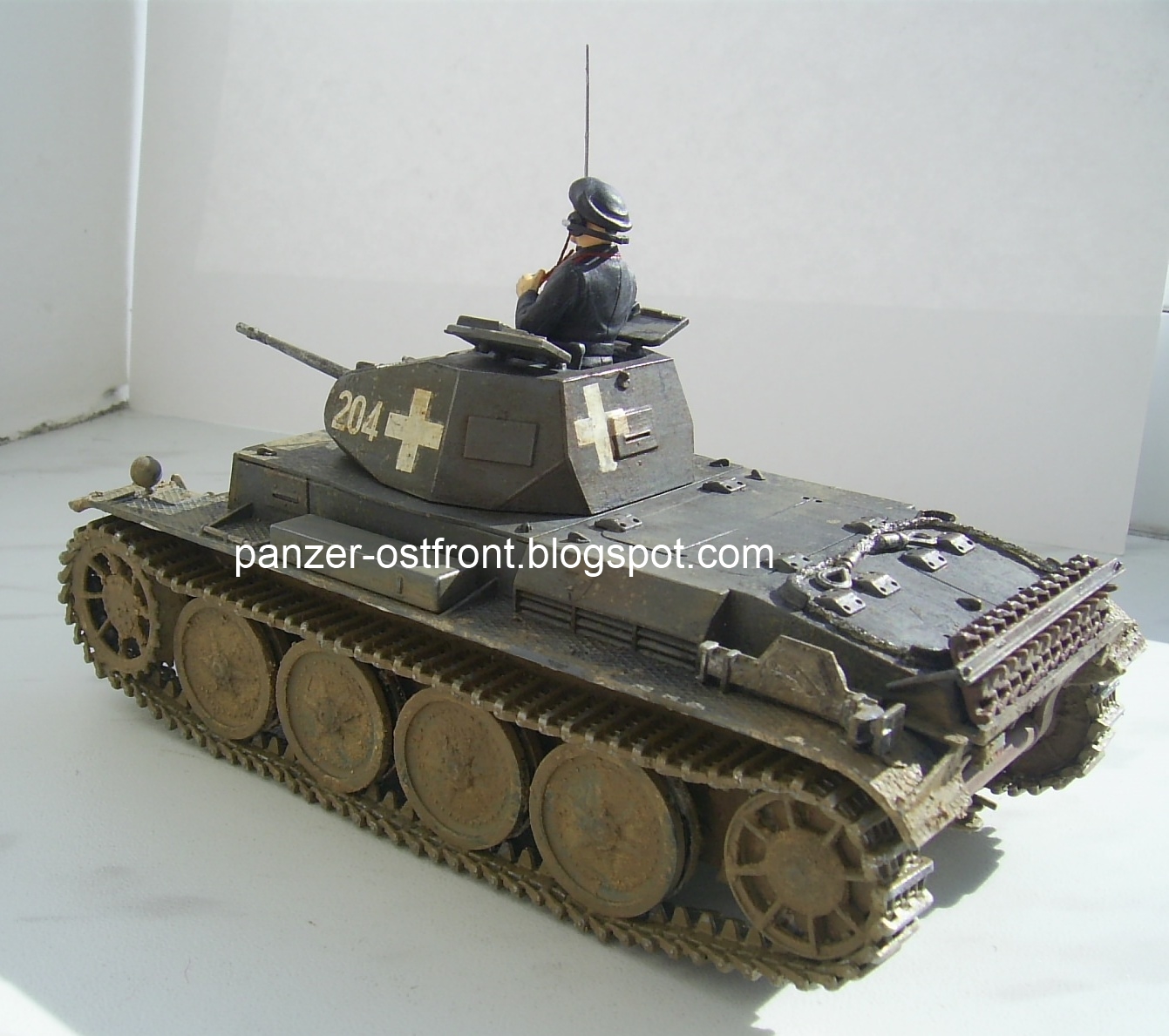
ICM. PzKpfw II Ausf D (WW II German light tank) 1/35

Німецькій легкий танк PzKpfw II Ausf D (SdKfz 121) - одна з найбільш швидкістних гусеничних машин періоду II Світової війни. Розробка "швидкісного танка" була почата німецькою фірмою Даймлер-Бенц в 1938 році. Машина була призначена для оснащення кавалерійських і "легких" дивізій вермахту. Від більш ранніх модифікацій танка Pz II її відрізняла форма корпусу, а також ходова частина з чотирьох катків великого діаметру, підвішених на торсіонах. Танк Pz II D розвивав швидкість до 55 км/г. На заводах фірми MAN було збудовано всього 143 машини, опісля частина з них була перероблена в вогнеметні танки PzKpfw II Flamm (SdKfz 122). Танки PzKpfw II D приймали участь в Польській і Французькій компаніях вермахту (1939-1940р.р.)

Panzer II Ausf. D and E
With a completely new torsion bar suspension with four road wheels, the Ausf. D was developed as a tank for use in the cavalry divisions. Only the turret was the same as the Ausf. C model, with a new hull and superstructure design and the use of a Maybach HL62TRM engine driving a seven-gear transmission (plus reverse). The design was shorter (4.65 m) but wider (2.3 m) and taller (2.06 m) than the Ausf. C. Speed was increased to 55 km/h. A total of 143 Ausf. D and Ausf. E tanks were built from May 1938 through August 1939 by MAN, and they served in Poland. They were withdrawn in March 1940 for conversion to other types after proving to have poor off-road performance. The Ausf. E improved some small items of the suspension, but was otherwise similar and served alongside the Ausf. D.